
Disclosure: As an Amazon Associate I earn from qualifying purchases. How this site works
Indoor vs Outdoor TV Antenna
Height and a clear path to the towers are the biggest factors in reception.
Quick answer
Indoor vs outdoor TV antenna: choose an indoor antenna when your desired stations are close, strong, and roughly facing a usable window or outside wall. Choose an outdoor antenna when signals are weak, blocked by hills or building materials, or include VHF channels that small flat antennas miss. Outdoor usually wins for reception; indoor wins for easy setup.
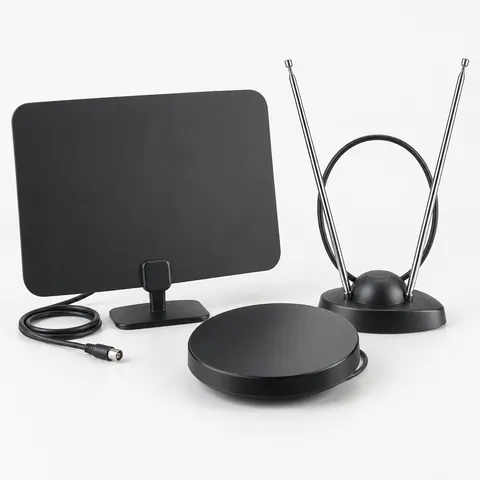 Indoor TV antennas
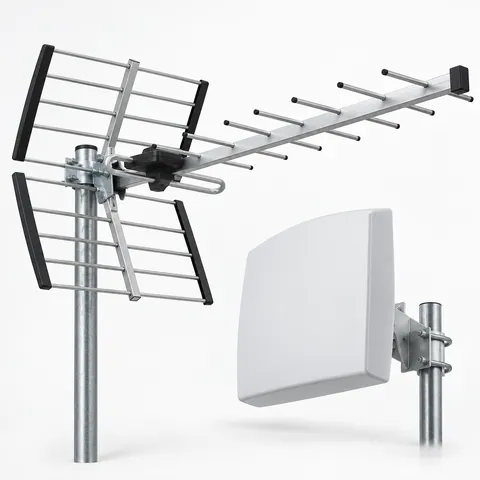 Outdoor TV antennas
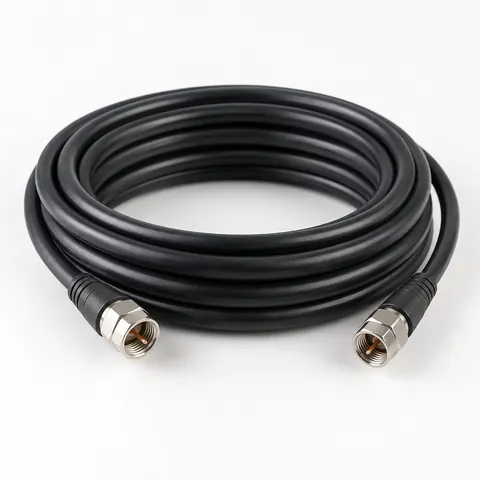 RG6 coax cable
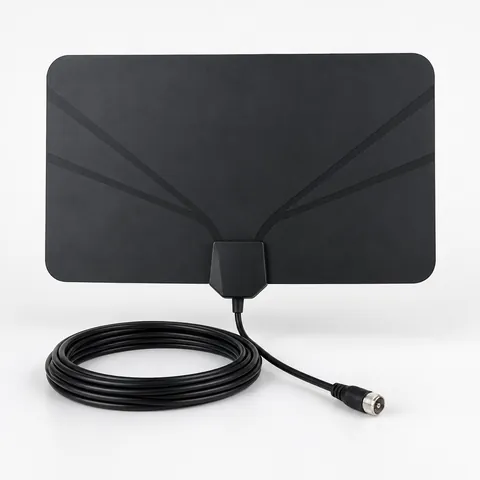 Attic TV antennas
Indoor vs Outdoor TV Antenna Quick Choice
Use this quick guide to decide which antenna type to try first.
| Situation | Try first | Reason |
|---|---|---|
| Strong nearby stations | Indoor | Fast, simple setup |
| Weak or distant stations | Outdoor | More height, fewer walls |
| No roof access | Indoor or attic | Lower commitment |
| Metal, brick, stucco, foil insulation | Outdoor | Buildings can block signal |
| Important VHF channels | Outdoor or VHF-rated | Small flat antennas may struggle |
| Apartment or rental | Indoor | Easy to move or return |
Comparison
| Indoor | Attic | Outdoor | |
|---|---|---|---|
| Installation | Minutes | An afternoon | Mast or roof mount |
| Height | Low | Medium | Highest |
| Obstructions | Walls, windows | Roof materials | Fewest |
| Weak / distant signals | Poor | Fair | Best |
| Weather exposure | None | None | Needs sturdy mounting |
Rules of thumb
- Towers close and strong: indoor.
- Moderate distance, no roof access: attic.
- Weak signals or hills in the way: outdoor, directional.
Compare indoor and outdoor antennas.
Attic tips
Metal roofing, foil-backed insulation and solar panels block signals. Mount the antenna as high as possible and away from ductwork and wiring.
How to choose using a TV signal report
Before buying, look up your address on a TV signal map and note the direction, band, and strength of the stations you actually want. Do not choose only by the antenna's advertised mile range. Those claims cannot know your hills, trees, building materials, or where the broadcast towers sit.
Focus on three details: how many desired stations are in one direction, whether they broadcast on UHF or VHF, and whether the signal is listed as strong, moderate, or weak. If most towers are clustered together, a directional antenna is usually easier to aim and can reject some interference from other directions. If stations are spread around your home, an indoor or attic antenna with a wider reception pattern may be more convenient, but it may not pull in weak channels as well.
- Choose an indoor antenna when the wanted stations show strong signal and the tower direction faces a usable window or outside wall.
- Choose an attic antenna when signals are not quite strong enough indoors but you cannot or do not want to mount equipment outside.
- Choose an outdoor antenna when the report shows weak signals, VHF channels you care about, or towers blocked by terrain or heavy construction.
- Choose a directional outdoor antenna when you need to favor one tower cluster and reduce multipath reflections from buildings, hills, or trees.
Also check channel band, not just channel number shown on the TV. A station displayed as channel 7, 9, or 11 may not actually broadcast on that same RF channel. If your must-have station uses high-VHF, make sure the antenna is designed for VHF as well as UHF. Some very flat indoor antennas work best on UHF and can struggle with VHF even when the tower is not far away.
Indoor antenna checks before you give up on it
An indoor antenna is the easiest option to try, but small placement changes can matter. Before deciding it will not work, scan more than once and test several locations. A window is not always best if it faces away from the towers or has metal screen, low-emissivity glass, or nearby siding that blocks signal.
Use the shortest practical cable at first and connect directly to one TV. Avoid splitters while testing because every split reduces signal. If the antenna includes a removable amplifier, test with and without it. Amplifiers can help when cable loss is the problem, but they can also overload a TV tuner when nearby stations are already strong.
- Find the tower direction from a signal report and place the antenna on the side of the room facing that direction.
- Raise the antenna as high as the cable allows, such as near the top of a window or wall.
- Run a fresh channel scan after each major move, not just after plugging it in.
- Test both flat-on-wall and rotated positions if the antenna shape allows it.
- Keep the antenna away from routers, computers, LED light power supplies, and large metal objects.
- After you find the best spot, secure the cable so the antenna does not shift when curtains, pets, or furniture move.
If you rent or live in a dorm, a basic indoor antenna is the lowest-commitment starting point. Pick one with a return policy, the right VHF/UHF support for your local stations, and a cable long enough to reach a high test location.
What changes when you move outside
Outdoor mounting helps because it raises the antenna and removes many indoor obstructions. It also adds responsibilities: weatherproofing, safe mounting, grounding where required, and routing cable without creating leaks. The reception gain from moving outdoors can be larger than changing from one indoor design to another, especially when the home has stucco mesh, brick, stone veneer, metal siding, or foil-backed insulation.
An outdoor antenna does not have to be on the highest part of the roof to work well. The best location is the spot with a clear path toward the tower direction, a solid mounting surface, and a cable route that is safe and serviceable. A gable end, fascia area, chimney mount, or freestanding mast may all work depending on the house, but the mount must handle wind and should not rely on weak trim boards.
Use outdoor-rated hardware and seal every exterior penetration. Coax should have a drip loop before it enters the house so water does not follow the cable indoors. Connections outside should use weather boots or sealing tape, and cable should be secured so it cannot rub on shingles, metal edges, or gutters.
| Decision point | Indoor | Outdoor |
|---|---|---|
| Best first try when | Stations are strong and nearby | Signals are weak, blocked, or inconsistent |
| Main advantage | Fast setup and no weather exposure | More height and fewer building losses |
| Main trade-off | More affected by walls and room electronics | More installation work and maintenance |
| Cable concerns | Keep it short and avoid splitters while testing | Use outdoor-rated routing and quality RG6 |
| When to reconsider | Pixelation continues in every room position | Mounting location cannot be made safe or stable |
If your report shows several weak but important channels, a properly aimed outdoor antenna is usually the more durable solution than stacking indoor fixes. Plan for the full installation, including a stable mount, grounding needs, and enough RG6 coax cable to avoid tight bends and poor routing.
Avoiding common buying mistakes
The most common mistake is buying for maximum advertised range instead of buying for local conditions. A larger antenna is not automatically better in every home. In a strong-signal area, too much gain or amplification can overload the tuner and cause missing channels. In a weak-signal area, a tiny amplified antenna may only make noise louder if the antenna element itself is not receiving a clean signal.
Another mistake is ignoring VHF. Many antennas are marketed for digital TV, HD, or 4K, but picture resolution does not determine reception. Broadcast reception depends on frequency band, signal strength, antenna placement, and tuner quality. If a wanted station uses VHF, choose an antenna that specifically includes VHF capability and allow enough physical size for those longer wavelengths.
Do not assume one antenna can feed every TV without planning. Splitting the signal to multiple rooms adds loss, and long cable runs add more. Start by proving reception on one TV. Then add splitters, longer cable, or distribution equipment only after you know the antenna location works.
Finally, do not skip rescanning. TVs store the channels found during a scan, and moving an antenna without rescanning can make a good location look bad. If your TV has separate scan options for cable and antenna, make sure it is set to antenna or air mode.
Frequently asked questions
Outdoor vs indoor TV antenna: which gets more channels?
An outdoor antenna often gets more channels because it can be mounted higher with fewer obstructions. In a strong-signal area, though, an indoor antenna may receive the same main local stations.
Can an indoor TV antenna be used outside?
Most indoor TV antennas are not built for rain, sun, wind, or outdoor mounting. Use an outdoor-rated antenna, weatherproof connections, and proper cable routing for exterior installs.
Is an outdoor antenna worth it for TV reception?
It is worth considering if indoor reception still pixelates after testing several high locations. Moving outside can reduce wall and roof losses and help with weak or VHF signals.
Is an outdoor TV antenna always better than an indoor antenna?
Not always. An outdoor antenna usually has the advantage of height and fewer obstructions, but a home near strong towers may work perfectly with an indoor antenna. If indoor reception is stable on the channels you watch, moving outside may add work without a meaningful benefit.
Can I put an outdoor antenna in the attic?
Sometimes, but performance depends on the antenna size, roof materials, and space for aiming. An outdoor-style antenna in an attic is protected from weather, but it still has to receive through roofing and nearby materials. Metal roofing, radiant barriers, ductwork, and solar equipment can make an attic location perform poorly.
Do I need an amplifier for an indoor or outdoor antenna?
An amplifier is not a cure for a bad antenna location. It can help offset cable loss, long runs, or splitting to multiple TVs, but it can also make reception worse if signals are already strong. Test without amplification first when possible, then add it only if the basic signal is clean but becomes weak after cable or splitter loss.
Why do some channels disappear at night or in bad weather?
TV signals can change with moisture, wind, temperature layers, and moving tree leaves. Marginal setups show those changes as pixelation or missing channels. Raising the antenna, improving aim, reducing splitters, or moving from indoor to attic or outdoor can add the signal margin needed for stable reception.
Should I use an omnidirectional or directional TV antenna?
Use an omnidirectional antenna when desired stations are strong and come from several directions. Use a directional antenna when the main stations are in one tower cluster, signals are weak, or reflections are causing dropouts. Directional antennas require more careful aiming but often provide more reliable reception for distant stations.
Disclosure: As an Amazon Associate I earn from qualifying purchases. This site may earn a commission when you buy through its links, at no extra cost to you. Product details come from public manufacturer information; always check the merchant page for current specifications and prices. We have not hands-on tested the products described here.